
Understanding Male Hair Loss: DHT, Follicle Miniaturization, and Bioactive Solutions
Male pattern hair loss, also known as androgenetic alopecia, is the most common form of hair thinning in men – affecting about 50% of men by age 50 and up to 80% by age 80 ishrs.org. It typically presents with a receding hairline or thinning at the crown, following characteristic patterns of baldness. Men in the early stages of hair fall often notice gradual thinning along the temples (an M-shaped recession) and diffuse thinning on the top of the scalp or crown belgraviacentre.comhealthline.com. To address hair loss effectively, it is crucial to understand the biological mechanisms behind it – particularly the role of hormones like dihydrotestosterone (DHT) and the process of hair follicle miniaturization. Armed with this scientific understanding, we can then explore clinically proven remedies and innovative bioactive solutions that help reduce thinning and promote lush, healthy hair.
The Role of DHT in Male Hair Thinning
Androgenetic alopecia is fundamentally driven by genetics and hormones. The main hormonal culprit is dihydrotestosterone (DHT) – a potent derivative of testosterone – acting on susceptible hair follicles ishrs.org. In the scalp, about 10% of circulating testosterone is naturally converted into DHT by an enzyme called 5-alpha-reductase (5-AR) healthline.com. Hair follicles along the front and crown of the scalp in genetically predisposed men have androgen receptors that bind DHT readily. In fact, DHT binds to these follicle receptors with about five times greater affinity than testosterone medicalnewstoday.com.
Once DHT attaches to the follicle’s receptors, it triggers changes that gradually shrink the hair follicle. Over time, high DHT levels shorten the hair’s growth cycle, leading to hairs that grow in thinner, weaker, and more brittle healthline.combelgraviacentre.com. DHT essentially overstimulates the follicles, pushing them to spend less time in the growth phase (anagen) and more time in the resting phase (telogen) medicalnewstoday.comhealthline.com. As a result, new hairs emerge finer and shorter with each cycle, and they shed more easily. This hormone-driven biological process is known as follicular miniaturization, and it is the primary mechanism behind male pattern baldnessbernsteinmedical.combelgraviacentre.com.
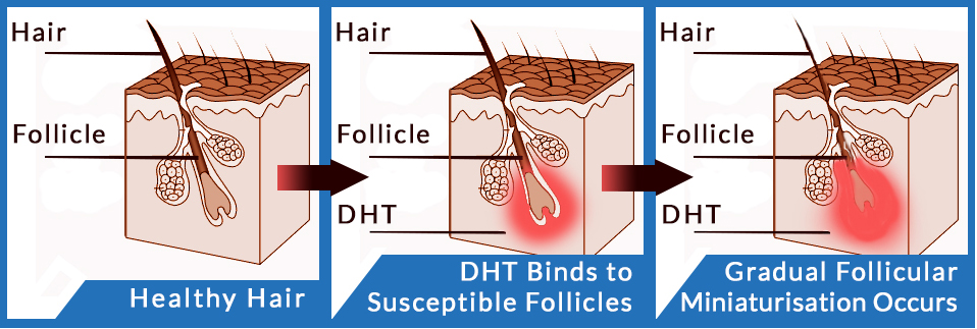
Illustration of how DHT binds to susceptible hair follicles and causesgradual follicular miniaturization. Over successive hair growth cycles, the affected follicles produce thinner and shorter hairs until growth ceases, leading to visible thinning and balding. Source: Belgravia Centre (2017)
In practical terms, follicular miniaturization means that what were once thick, pigmented terminal hairs are progressively transformed into fine, wispy vellus hairs that provide little coverage. Men typically notice this as a receding hairline or a widening bald spot on the crown. The sides and back of the scalp are often spared because follicles there are genetically DHT-resistant (hairs in these areas remain permanent and are often used as donor grafts in hair transplantation) ishrs.orgbernsteinmedical.com. But on the top front of the scalp, DHT’s effects accumulate: hair follicles become so small that they can no longer penetrate through the scalp surface, resulting in eventual baldness if the process isn’t intervened.
Hair Growth Cycle Disruption and Follicle Miniaturization
Under healthy conditions, each hair follicle cycles through growth and rest phases. A normal scalp hair spends 2–7 years in the anagen (growth) phase, during which it actively produces a thick hair strand. This is followed by a brief catagen (transitional) phase, and then a telogen (resting) phase of a few months after which the hair sheds bernsteinmedical.com. New hair then grows from the follicle, and the cycle repeats. At any given time, the majority of hair follicles are in anagen, which is why a healthy scalp maintains dense hair coverage.
DHT disrupts this balance by shortening the anagen phase of susceptible follicles bernsteinmedical.com. With each cycle, the growth phase becomes so truncated that the new hair has less time to elongate and thicken. The hairs emerge thinner, and more follicles enter telogen prematurely. Men may notice that lost hairs are not being fully replaced by equally long, thick strands. Over successive cycles, continued DHT exposure causes cumulative miniaturization – the follicle shrinks in diameter, the hair produced is microscopically finer, and the follicle’s depth in the scalp shallows. Eventually, the follicle might produce only tiny, nearly invisible hairs or none at all bernsteinmedical.combelgraviacentre.com.
Clinically, this miniaturization process is insidious and progressive. Early on, one might observe just a drop in hair volume or density. As more follicles miniaturize, the scalp becomes visible through the thinning hair. The frontal hairline starts to migrate backwards and the vertex (crown) develops a thinning spot. These areas correspond to the classic Male Pattern Baldness regions. If untreated, the end stage is often a horseshoe-shaped pattern of hair remaining on the back and sides of the head, with complete baldness on top belgraviacentre.comcommons.wikimedia.org.
It’s important to note that DHT-driven hair loss doesn’t happen overnight – it’s a gradual process that can start in a man’s early 20s or 30s and unfold over years or decades. The earlier the intervention, the greater the chance of halting or even partially reversing the miniaturization before follicles are permanently lost sciencedirect.comishrs.org. Modern treatments aim to protect and revive these vulnerable follicles by either reducing the impact of DHT or by stimulating the follicles to re-enter a robust growth phase.
DHT Blockers and 5-Alpha-Reductase Inhibitors
Given DHT’s central role, one cornerstone of treatment is to block the formation or action of DHT. This is where the enzyme 5-alpha-reductase comes in. There are two main isoforms of 5-AR in the body (type II is prevalent in hair follicles and the prostate). Medications like finasteride specifically inhibit 5-AR type II, thereby reducing the conversion of testosterone to DHT in the scalp. By lowering DHT levels, finasteride effectively lifts the hormonal pressure off the follicles. In clinical trials, daily finasteride successfully slowed the progression of hair loss and increased hair regrowth in men over 2 years pubmed.ncbi.nlm.nih.govpubmed.ncbi.nlm.nih.gov. On average, men taking finasteride 1 mg have higher hair counts and thicker hair strands compared to those on placebo, who continue to lose hair pubmed.ncbi.nlm.nih.gov. This medication has become a first-line DHT-blocking therapy for male pattern baldness, helping to preserve hair follicles in about 9 out of 10 men and yielding noticeable regrowth in a significant subset of users.
Another proven therapy is topical minoxidil, which is not a DHT blocker but a hair growth stimulant. Minoxidil solution or foam is applied to the scalp to prolong the anagen phase and increase blood flow to hair follicles. As a vasodilator, minoxidil widens blood vessels and improves microcirculation in the scalp, delivering more oxygen and nutrients to support hair growth medicalnewstoday.com. It can help “wake up” follicles from the resting phase and stimulate new growth, often visible as fine baby hairs that gradually thicken. Minoxidil has been shown to increase hair density and is an effective adjunct or alternative for those who cannot take oral medications.
While finasteride and minoxidil are clinically proven and FDA-approved treatments, they may not be suitable for everyone. For example the use of finasteride can include side effects like sexual dysfunction including decreased libido, erectile dysfunction, and reduced ejaculatory volume is reported in 1.8%–3.8% of users. In some cases, these effects persist even after discontinuation — a condition known as post-finasteride syndrome (Mondaini et al., 2007; Traish et al., 2011). Other psychological effects, include such as anxiety, depression, and brain fog, have been documented, particularly among long-term users. (Ganzer et al., 2015; Irwig, 2012)
Minoxidil on the other hand is a superficial relief with limited reach. It has notable limitations such as Scalp irritation (itchiness, dryness, flaking) occurs in many users due to alcohol-based formulations. (Olsen et al., 2002; Messenger & Rundegren, 2004). Another factor is the dependency on the product. Users often experience increased hair fall in the initial weeks and need lifelong use to sustain benefits. Hair loss typically resumes once treatment is stopped.
(Blume-Peytavi et al., 2011)
Therefore the question is; do you have a solution that has zero side-effects? This has spurred interest in natural DHT blockers and bioactive topical solutions that can be applied directly to the scalp with no side effect risk. These solutions aim to mimic the beneficial effects of conventional treatments using plant-derived or nutrient-based compounds.
Natural Bioactive Compounds for Hair Loss
Research has identified several natural extracts and nutrients that exhibit properties conducive to hair growth and follicle health. Many of these work by either inhibiting 5-alpha-reductase (thus reducing DHT) or by stimulating follicle activity through other pathways. Some notable examples include:
- Saw Palmetto Extract: Derived from the berry of the Serenoa repens palm, saw palmetto is believed to block 5-alpha-reductase, much like finasteride, thereby lowering DHT levels around hair follicles healthline.com. Though research is still emerging, one study using a topical saw palmetto serum (with biotin and other botanicals) found that nearly half of men had a modest increase (around 12%) in hair count after 4 months healthline.com. Saw palmetto is a popular herbal option for those seeking a natural DHT blocker, and its components work similarly to synthetic anti-androgens in terms of enzyme inhibition healthline.com.
- Pumpkin Seed Oil: Pumpkin seeds contain delta-7 sterols, compounds that may interfere with DHT binding in the scalp. A 2019 study on mice showed that topical pumpkin seed oil application could counteract testosterone-induced hair loss and actually promoted new hair growth within weeks healthline.com. Human trials are limited, but a small study of oral pumpkin seed oil in men noted an improvement in hair density compared to placebo, suggesting a beneficial effect on androgenic hair loss.
- Caffeine: Beyond its well-known stimulant properties, caffeine has intriguing effects on hair follicles. Laboratory studies have found that caffeine can extend the anagen (growth) phase of hair follicles and counteract DHT’s suppressive effect on follicle proliferation healthline.com. In practical terms, caffeine applied topically (for example, in caffeinated shampoos or serums) may penetrate the hair follicle and encourage longer, thicker hair growth. Though more research is needed, caffeine’s ability to promote keratin production and hair shaft elongation makes it a promising supportive ingredient healthline.com.
- Biotin and B-Vitamins: Biotin (vitamin B7) is frequently marketed for hair health, and while severe biotin deficiency can cause hair loss, most people get enough from their diet. Still, B-vitamins (like B6, B12, folate) are crucial for cell metabolism and keratin formation. Ensuring the scalp and follicles have an adequate supply of vitamins may help hairs grow to their full thickness and strength. Some supplement regimens combine biotin with zinc and silica for supporting hair structure, though evidence for preventing genetic hair loss is limited medicalnewstoday.com.
- Antioxidant-Rich Botanicals: Oxidative stress and inflammation in the scalp can exacerbate hair follicle miniaturization. Natural antioxidants from plant oils and extracts – such as rosemary oil, green tea (EGCG), ginseng, or amla – have been explored for hair benefits. For instance, rosemary essential oil was compared head-to-head with minoxidil 2% in a small trial and showed a similar improvement in hair count over 6 months, with fewer side effects (notably less scalp itching) – suggesting it helps with scalp microcirculation and has anti-androgenic effects. Green tea polyphenols (EGCG) may protect follicles from DHT damage by downregulating 5-AR and reducing inflammation. While these natural agents typically have milder effects than pharmaceuticals, they can complement a hair care regimen and are especially useful in early-stage thinning or as maintenance after more intensive treatment.
Collectively, these bioactive compounds represent a multi-pronged approach to hair rejuvenation: some reduce the hormonal driver (DHT) and others directly nourish or stimulate the follicles. Modern topical formulations are increasingly combining several of these ingredients to achieve synergistic effects. The advantage of a topical bioactive solution is that it delivers nutrients and actives directly to the scalp, bypassing systemic circulation. This targeted delivery can be highly beneficial for men who have poor nutrient absorption from diet or who cannot tolerate oral medications. By feeding the hair follicles from the outside, such treatments ensure that even if one’s body has difficulty absorbing certain vitamins or minerals, the scalp still gets a concentrated dose of growth-promoting factors.
Amrutveni Hair Elixir for Men: Harnessing Bioactive Science for Hair Growth
One exemplary product that embodies this science-based, holistic approach is Amrutveni Hair Elixir for Men. This formulation is a biotechnology-driven topical elixir infused with potent natural bioactives, vitamins, and minerals specifically chosen to combat hair thinning at the root level. Developed by Sahyadri Bio Labs (SBL) after years of research in advanced biotechnology, the elixir uses a proprietary Sahyadri Process to infuse a rich spectrum of nutrients into a “poly-herbal” oil base zipleaf.in. The result is a concentrated yet lightweight serum that can penetrate the scalp efficiently and invigorate the hair follicles.
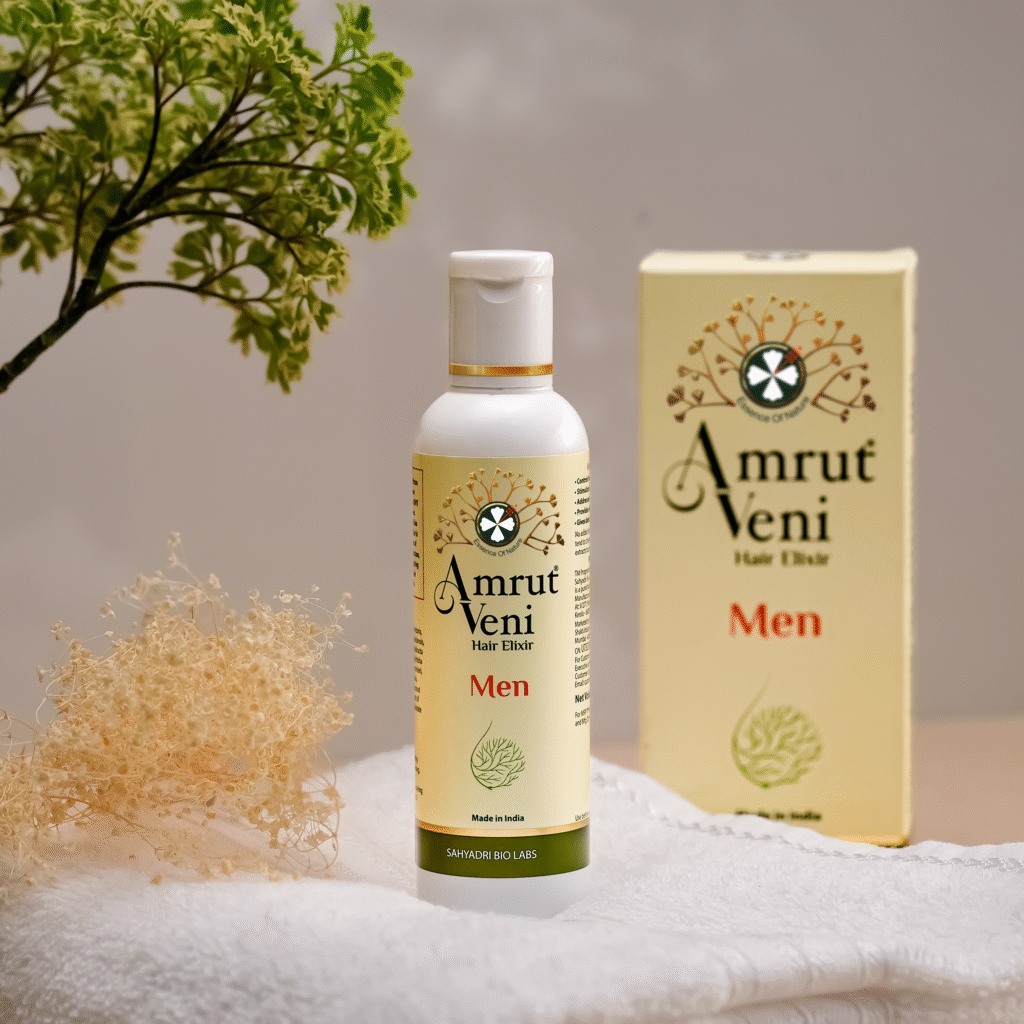
Key scientific features and benefits of Amrutveni Hair Elixir for Men include:
- Natural 5-Alpha-Reductase Inhibitors: The elixir contains herbal extracts that act as plant-derived DHT blockers. By inhibiting 5-AR, these bioactives reduce the local production of DHT in the scalp, thereby protecting follicles from hormone-induced miniaturization (similar to how saw palmetto works) healthline.com. Regular use helps halt the weakening of hair follicles, preserving their size and function.
- Nutrient-Rich Formula for Follicle Nutrition: Amrutveni is packed with vitamins A, B-complex, C, D, E, K and essential minerals like calcium, magnesium, zinc, iron, and selenium – all derived from herbal sources zipleaf.in. Via the Sahyadri Process, these nutrients are bio-available and delivered directly to the hair roots. This topical nourishment is highly effective even for individuals with poor dietary nutrient absorption, as it feeds the scalp directly with the building blocks needed for hair growth and strength.
- Enhanced Vasodilation and Microcirculation: The formulation improves scalp blood flow (through ingredients that encourage gentle vasodilation), ensuring that hair roots receive ample oxygen and metabolic support. Better circulation means toxins are removed and more growth factors reach the follicles, creating an optimal environment for longer growth cycles and thicker strands – a mechanism analogous to how minoxidil stimulates hair growth by boosting blood supply medicalnewstoday.com.
- Stronger, Thicker and Longer-Lasting Hair: With consistent application, users can expect to see thicker hair strands and stronger roots. By prolonging the anagen phase and supplying protein precursors and antioxidants, the elixir helps each hair grow longer and more robust before it sheds. Many users report increased hair density and reduced breakage/shedding after incorporating these bioactives into their routine, indicating more hairs are staying in the growth phase.
- Restored Shine and Volume: The Elixir’s blend of potent bioactives that also works to improve the quality of the hair shaft. Nutrients like vitamin E and essential fatty acids condition the scalp and hair, restoring natural shine and volume to hair that may have become dull or brittle from DHT effects or environmental damage. Over time, hair not only grows fuller but also looks healthier – with revived lustre and bounce.
- Non-Greasy, Fast-Absorbing Formula: Unlike traditional hair oils, Amrutveni’s elixir has a refined, lightweight consistency. It absorbs quickly into the scalp without leaving a heavy or greasy residue. This makes it ideal as a pre-shower scalp ritual – you can massage it in before your morning shower, let the bioactives penetrate for 15–20 minutes, and then rinse it with Amrutveni hair cleansing nectar which is a great combo for maximum benefits. It doesn’t weigh down the hair, so even daily use won’t make your hair look oily or flat. The quick absorption also means the active ingredients reach the follicles efficiently to start working on strengthening your hair from the roots.
- Supports Chemically Treated or Damaged Hair: If your hair has been subjected to chemical treatments (dyes, straightening, etc.) or harsh styling, the Amrutveni Hair Elixir can aid in fast recovery and repair. Its herbal proteins and vitamins help mend micro-damage in the hair shaft and soothe scalp irritation from chemicals. By reinforcing the hair cuticle and providing nourishment, it mitigates issues like post-colour dryness, frizz, or thinning. This makes it beneficial not only for genetic hair loss but also for improving overall hair resilience and condition.
Crucially, Amrutveni Hair Elixir for Men is clinically backed. According to the manufacturer’s data and user trials, the formula has been proven to increase hair growth rate and hair mass index, validating its multi-faceted approach (DHT inhibition + nutrition + stimulation). The use of the Sahyadri Process, a biotechnology-based infusion technique, sets it apart – ensuring that the phyto-active compounds and micronutrients are preserved in their most efficacious form and delivered in an optimal ratio. Only SBL employs this advanced process of combining diverse herbal extracts into a stable, potent elixir zipleaf.in.
Conclusion
Male hair loss can be a distressing experience, but understanding the science behind it empowers men to take effective action. DHT-driven follicle miniaturization is at the heart of male pattern baldness, causing hairs to progressively thin out and the hair growth cycle to shorten. Fortunately, modern science offers multiple strategies to combat this. Traditional medications like finasteride (to block DHT) and minoxidil (to stimulate growth) have shown excellent efficacy in preserving hair and even reversing some loss medicalnewstoday.compubmed.ncbi.nlm.nih.gov. But there are side effects. Alongside these, emerging bioactive topical solutions provide a more natural yet scientifically grounded approach – targeting the same biological pathways using herbs, nutrients, and innovative delivery methods. And the best part there are no side effects.
For men in the early stages of hair thinning, an integrative approach can yield the best results. This might include lifestyle changes (scalp care, nutrition, stress reduction) combined with a topical hair and scalp applications like Amrutveni Hair Elixir for Men as a daily ritual to fortify and defend the hair. By inhibiting DHT locally, nourishing the scalp, and invigorating blood flow, such an elixir delivers comprehensive care to retain hair density and quality. The journey to lush, healthy hair is a gradual one, but with consistent use of clinically-backed solutions and an understanding of one’s hair biology, men can significantly slow down hair loss and even regrow stronger, thicker hair than before. Early intervention is key – the sooner one addresses follicle miniaturization with proven science, the better the chances of keeping a full head of hair that is a genuine crown of confidence.
References
- Ustuner ET. Cause of Androgenic Alopecia: Crux of the Matter. Plastic & Reconstructive Surgery – Global Open. 2013;1:e64. DOI: 10.1097/GOX.0000000000000005. (Insight into the proposed mechanisms of follicular miniaturization in AGA)medicalnewstoday.comhealthline.com
- ISHRS – Orentreich N, et al. Androgenetic Alopecia: A Guide to Pattern Hair Loss. International Society of Hair Restoration Surgery (2018). (Overview of male pattern baldness prevalence and hormonal causes)ishrs.orgishrs.org
- Belgravia Centre – Doclis L. What is Follicular Miniaturisation in Relation to Hair Loss? Belgravia Hair Loss Blog (2017). (Explains how DHT causes hair follicle shrinkage and pattern of loss in men)belgraviacentre.combelgraviacentre.com
- Bernstein Medical – Miniaturization: The Mechanism in Genetic Balding. BernsteinMedical.com (Hair Restoration Physician Resources). (Defines miniaturization and the role of DHT in shortening the hair growth cycle)bernsteinmedical.combernsteinmedical.com
- Medical News Today – Moore E. DHT (dihydrotestosterone) and its link to hair loss. MNT News (2020). (Discusses how DHT affects hair follicles and treatments like finasteride and minoxidil)medicalnewstoday.commedicalnewstoday.com
- Healthline – Cherney K. DHT: How It Causes Hair Loss and How to Slow It. Healthline (2021). (Details the conversion of testosterone to DHT via 5-AR and natural ways to counter DHT’s effects)healthline.comhealthline.com
- Kaufman KD et al. Finasteride in the treatment of men with androgenetic alopecia. Journal of the American Academy of Dermatology 1998;39(4):578-589. (Clinical trial demonstrating finasteride’s efficacy in slowing hair loss and increasing hair growth)pubmed.ncbi.nlm.nih.govpubmed.ncbi.nlm.nih.gov
- Healthline – Ellis ME. Saw Palmetto for Hair Loss: Myth or Miracle? Healthline (2018). (Reviews evidence for saw palmetto as a natural 5-AR inhibitor and its effect on hair loss)healthline.comhealthline.com
- Healthline – Kubala J. 5 Promising Benefits and Uses of Saw Palmetto. Healthline (2020). (Notes saw palmetto’s DHT-blocking ability and its use in BPH and pattern hair loss)healthline.com
- Zancanaro PQ et al. Topical Pumpkin Seed Oil Extracts: Effects on Hair Growth in C57BL/6 Mice. Journal of Cosmetic Dermatology (2019). (Study showing pumpkin seed oil’s hair growth promotion in an animal model of androgenetic alopecia)healthline.com
- Fischer TW et al. Effect of caffeine and testosterone on the proliferation of human hair follicles in vitro.International Journal of Dermatology (2007). (Findings that caffeine stimulates hair shaft elongation and may counteract testosterone/DHT effects)healthline.com
- Zipleaf Business Directory – Amrut Veni – Herbal Hair Oil from the Essence of Nature. Zipleaf.in (2025). (Company overview of Amrutveni, listing its vitamins, minerals content and the Sahyadri Process used to infuse bioactives)zipleaf.in
- Amrutveni (Sahyadri Bio Labs) – Product Information: AmrutVeni Hair Elixir for Men. Company Brochure/Website (2022). (Clinical and technical details on the formulation’s 5-AR inhibition, nutrient delivery, and efficacy for hair growth)zipleaf.inhealthline.com
- Panahi Y et al. Rosemary Oil vs Minoxidil 2% for the Treatment of Androgenetic Alopecia: A Randomized Comparative Trial. SKINmed 2015;13(1):15-21. (Evidence that rosemary oil can improve hair count similar to minoxidil, supporting natural vasodilators in hair loss)medicalnewstoday.com
- Dhurat R et al. Randomized Evaluation of Microneedling vs Minoxidil 5% vs Combined Therapy in Androgenetic Alopecia. International Journal of Trichology 2013;5(1):6-11. (Additional context on stimulating follicles and enhancing topical absorption, relevant to advanced treatments like the Sahyadri Process).